Early life
According to the most reports, Imam Husayn ibn Ali was born on 3 Sha'aban 4 AH/10 January 626 CE.
He and his brother Imam Hassan were the only descendants of Muhammad who remained alive. Many of the accounts about Muhammad's treatment of his grandsons and his great love for them deal with them together and at times confuse them.Muhammad is reported to have said that "whoever loves them [his grandsons] loves me and whoever hates them hates me" and "al-Hasan and al-Husayn are the sayyids of the youth of Paradise". The latter saying has been particularly important for Shias who used it in support of for the right of Muhammad's descendants to the imamate. Muhammad, according to other traditions, is pictured with his grandsons on his knees, on his shoulders, or even on his back during the prayer at the moment of prostrating himself.[According to Madelung, Muhammad loved them and declared them as his Ahl al-Bayt frequently. The Quran has accorded the Ahl al-Bayt of the Prophet an elevated position above the rest of the faithful.
In addition to these traditions, a number of traditions also involve presence of angels. From a Muslim point of view, these traditions do not create any problem but to non-Muslims they as appear legends created under the Shi'i influence.
The Incident of Mubahala
According to hadith collections, it is narrated that during the 9th - 10th year after hijra an Arab Christian envoy from Najran (currently in northern Yemen and partly in Saudi Arabia) came to Muhammad to argue which of the two parties erred in its doctrine concerning Jesus.
After likening Jesus' miraculous birth to Adam's creation Muhammad called them to Mubahala (Cursing), where each party should ask God to destroy the lying party and their families. Muhammad, to prove to them that he is a prophet, brought his daughter Syedda Fatimah(Taiba,Tahira) and his surviving grandchildren, Imam Hassan and Imam Hussain ibn Ali, and Ali ibn Abi Talib and came back to the Christians and said this is my family (Ahl al-Bayt) and covered himself and his family with a cloak.
Yazid caliphate
Muawiyah designated his son, Yazid I, as his successor before his death in 680CE.
The significance of Husayn's allegiance
When Yazid I became caliph he forced Husayn ibn Ali and Abd Allah ibn Zubayr to pledge alliance with him, but they refused and migrated from Madinah to Mecca in that year.
Uprising
Husayn left Medina with his households, his sons, brothers, and the sons of Hasan. He traveled the main road to Mecca, refusing to avoid being pursued by taking a side road. In Mecca Husayn stayed in the house of `Abbas ibn `Abd al-Muttalib and remained there for four months.
Husayn uprised against Yazid I and declared Umayyad rule was not only oppressive but also religiously misguided. In his view the integrity and survival of the Islamic community depended on the reestablishment of right guidance.
When Husayn was in Mecca open revolt began in Kufa, due to the fact that succession of Yazid I was the first attempt to establish a hereditary dynasty. Religious attitude against Umayyad and Iraqi tendencies to recapture power inspired people alongside with those who believe that leadership of the Muslim community rightly belonged to the descendants of Ali to rose and invite Husayn to Kufa to establish his caliphate. They urged Husayn to join them, since they had no imam. They informed him that they did not attend the Friday prayer with governor of Kufa, No'man ibn Bashir and would drive him out of the town as soon as Husayn agreed to come to them. They sent him in short order seven messages with bags of letters of support by Kufan warriors and tribal leaders. Husayn wrote the Kufans that he understood from their letters that they had no imam and they wished him to come to unite them by right guidance. He informed them that he was sending his cousin Moslem ibn Aqil to report to him on the situation. If he found them united as their letters indicated he would speedily join them, for it was the duty of the imam to act in accordance with the Qoran, to uphold justice, to proclaim the truth, and to dedicate himself to the cause of God. The mission of Moslem was initially successful. The Kufan Shias visited him freely, and 18,000 men are said to have enlisted with him in support of Husayn. He wrote to Husayn, encouraging him to come swiftly to Kufa.
Husayn was also visited by a Shia supporter with two of his sons from Basra, where Shia sentiment was otherwise limited. He then sent identical letters to the chiefs of the five divisions into which the Basran tribes were divided for administrative purposes. He wrote them that Muhammad's family were his legatees and heirs of his position. People had illegitimately claimed the right which belonged exclusively to the Prophet’s family. The family had consented to their action for the sake of the unity of the Ummah. Those who had seized the right of the Prophet’s family had set many things straight and had sought the truth. The contents of the letter closely reflected the guideline set by Ali, who had strongly upheld the sole right of the family of the Prophet to leadership of the Muslim community but had also praised the conduct of the first caliphs Abu Bakr and Omar. While most of the recipients of the letter kept it secret, one of them suspected that it was a ploy of the governor Ubayd-Allah ibn Ziad to test their loyalty and turned it over to him. Ubayd-Allah seized and beheaded Husayn’s messenger and addressed a stern warning to the people of Basra.
In Kufa the situation changed radically when Yazid replaced Noman ibn Bashir by Ubayd-Allah ibn Ziad, ordering the latter to deal severely with Moslem ibn Aqil. Ubayd-Allah succeeded in intimidating the tribal chiefs. A revolt collapsed when the rebels failed to capture the governor’s palace. Moslem was found and delivered to Ubayd-Allah, who had him beheaded on the top of the palace and his body thrown down to the crowd. Yazid wrote to Ubayd-Allah, commending him highly for his decisive action and ordering him to set up watches for Husayn and his supporters and to arrest them but to kill only those who would fight him.
On the other hand Yazid perceived Husayn's refusal to pledge allegiance as a danger to his throne. He plotted to kill the grandson of the prophet during the Hajj, in the precincts of the Holy Kaaba, thus defiling and desecrating it (killing a person in Mecca is prohibited in Islam). In order to avoid this sacrilege, Husayn took along his wives, children, a few friends and relatives and headed towards Kufa to fulfill the responsibility of the bearer of Imamate and to fulfill his destiny as was prophesied by his grandfather, Mohammad.
On his way, he was offered military support by the tribe of Banu Tayy as well as sanctuary in their hills from where he could (if he wanted to) safely lead a revolt and overthrow Yazid. But Husayn refused the offer and continued his journey with his few companions.
Battle of Karbala
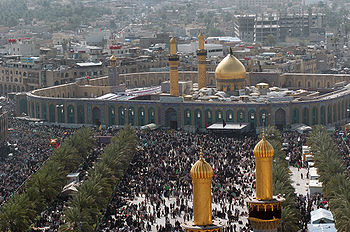
The Shrine of Imam Hussain ibn Ali in Karbala, Iraq
-
- Maqtal Al-Husayn.
Husayn in his path toward Kufa encountered the army of Ubayd-Allah ibn Ziyad, the governor of Kufa, led by al-Hurr al-Riyahi (a top commander in the Umayyad army who later changed sides).
At the Battle of Karbala it is recorded that seventy two people were martyred. [On his way toward Kufa, Husayn encountered the army of Ubayd-Allah ibn Ziyad, the governor of Kufa, which was led by Hurr. When he clashed with them he said
"... Don't you see that the truth is not put into action and the false is not prohibited? The believer should desire to meet his Lord while he is right. Thus I do not see death but as happiness, and living with tyrants but as sorrow."
Part of his speech on Ashura
"Behold; the illegitimate, son of the illegitimate [by birth], has settled between two, between unsheathing [the sword] and humiliation, and how impossible is humiliation from us! Allah refuses that for us, and his messenger, and the believers, and laps chastified and purified, and zealous noses [expression: heads that do not bow in humility], and repudiating souls [who repudiate/refuse oppression], that we desire obedience to the mean ones, than the killings of the honourable [martyrdom]. Behold that I move slowly with this family, despite the little number and deserting of helpers."
On 10 October 680 (Muharram 10, 61 AH), he and his small group of his followers and family members, who were between 108 and 136 people of Husayn ibn Ali (the grandson of Muhammad). fought with a large army of perhaps 4000 men under the command of Umar ibn Sa'ad, son of the founder of Kufah. Husayn and all of his men were killed and beheaded. The bodies were left three days without burial and all the heads and whomever was left from Husain's family were taken as prisoners to al-Sham (Syria and Lebanon today) to Yazid.
Today, the death of Hussein ibn Ali is commemorated during every Muharram, with the most important of these days being its tenth day, Ashura.
Burial
Husayn's body is buried in Karbala, near the site of his death. His head is said to have been returned from Damasqus and interred with his body.
Husayn's grave became the most visited place of Ziarat for Sunni and Shias. The Imam Husayn Shrine was later built over his grave. In 850 Abbasid caliph, al-Mutawakil, destroyed his shrine in order to stop Shia pilgrimages. However, pilgrimages continued.It is now a holy site of pilgrimage for Shia Muslims.
Commemoration of Husayn ibn Ali
-
Day of Ashura is
commemorated by the
Shi‘a as a day of mourning for the
martyrdom of
Husayn ibn Ali, the grandson of the
Islamic prophet Muhammad at the
Battle of Karbala. In some countries and regions such as
Iran,
Iraq,
Pakistan,
India,
Bahrain,
Trinidad and Tobago and
Jamaica Commemoration of Husayn ibn Ali has become a national holiday and all ethnic and religious communities participate in it.
It is especially mourn on the first ten days of Muharram, first month of the Islamic calendar, and ends by the 10th day. Although, the mourning continues through the whole month and well into Safar till eighth rabi-ul-awal, the third month in the Islamic calendar.
Sayings of Muhammad PBUH about Hussein ibn Ali AS in Sunni books
- "Al-Hasan and al-Hussein are the chiefs of the youth of Paradise and Fatimah is the chief of their women.
- Muhammad said, " Hussein is from me and I am from him.
- Muhammad looked toward Ali, Fatimah, Hasan, and Hussein, and then said, "I am in war with those who will fight you, and in peace with those who are peaceful to you.

